Welcome
GreenVitals Bookstore
Powered by Squarespace
Interactive Community


GreenVitals Search

Front Page

Entries in global warming (9)

Thursday
Jan052012

New York City Implementing New Green Technologies to Reduce Waterway Pollution

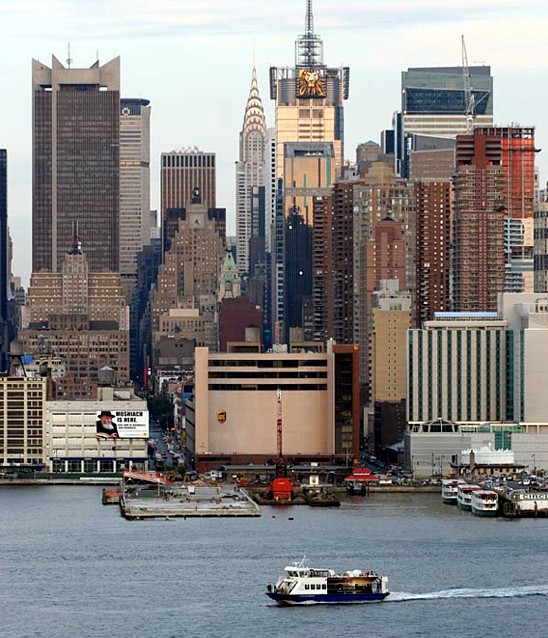
As part of New York City’s ongoing efforts to clean up the pollution in its surrounding waters, NY Waterway has decided to revamp nine of its ferries with new engines and catalysts designed to lower greenhouse gas emissions in the environment.

Photo courtesy of wirednewyork.com.

Part of the financing for this project will include $2.5 million in funding secured from a grant by the New York City Department of Transportation (NYC DOT) and a $900,000 contribution from the NY Waterway.

NY Waterway has also already converted the fleet to use 100 percent ultra-low sulfur diesel.

“The city has set a high standard with a cleaner retrofit for Staten Island ferry boats and equipping private fleets with this technology now brings a new standard to the industry in New York,” said DOT Commissioner Janette Sadik-Khan in a statement.

NY Waterway estimates that it carries about 35,000 passengers per day on 31 boats serving New Jersey, Manhattan, Brooklyn, Queens, Rockland, Westchester, Orange, and Dutchess County.

Click to read more ...

Friday
May062011

Global Warming’s Double Whammy: Reducing World Crop Yields and Increasing Food Prices

While many people still refuse to believe that global warming is real, the evidence for it continues to slowly grow, bringing frightening consequences – massive food shortages around the world, and skyrocketing prices for what food there is.

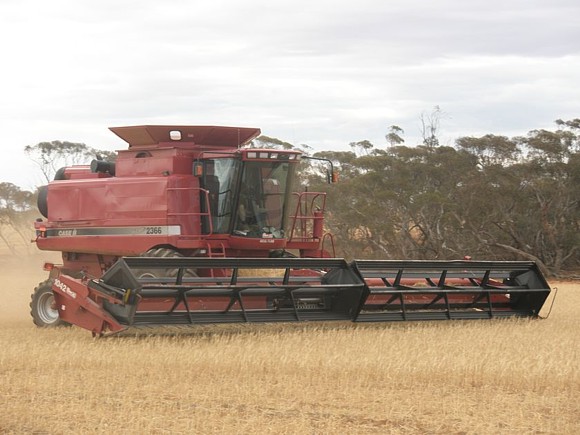
Stock photo.

This is especially true for staple crops, like wheat and corn. For most major agricultural countries, rising temperatures have had a damaging effected crop yields, resulting in below normal levels, especially of wheat and corn, said a new study by Stanford University.

David Lobell, the lead author of the study and an assistant professor of environmental Earth science at Stanford, said that he and his colleagues examined the temperature and rainfall records of major crop-growing countries over the last 30 years and did a comparative analysis of their crop yields.

The researchers found that global wheat production was 5.5 percent lower than what it would have been had climate remained stable. They also found that global corn production was lower by almost four percent.

Russia, India, and France suffered the greatest drops in wheat production relative to what they might have had without global warming. The largest comparative losses in corn production were seen in China and Brazil.

“Yields in most countries are still going up, but not as fast as we estimate they would be without [these] climate trends,” Mr. Lobell told the Stanford Report.

Click to read more ...

Thursday
Mar312011

The Amazon Rainforest – Earth’s Brazilian Lung Being Burned Down For Profit

Tropical rainforests are the lungs of the planet. Photosynthesis makes them massive carbon absorbers, regulating global climate. These rainforests generate most of the world’s rainfall and form a cooling band around the equator, acting as the Earth’s thermostat.

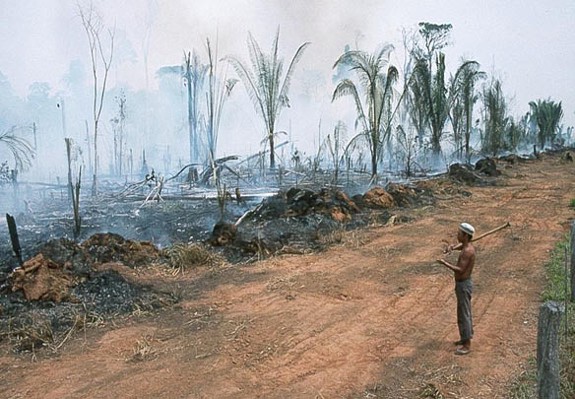
Amazon deforestation through burning. Photo courtesy Chris Neill/Marine Biological Laboratory.Cutting down forests causes two major problems - removing the planet’s natural carbon absorber, and adding more carbon into the atmosphere because many trees are cleared by burning. Too much carbon dioxide heats up the atmosphere, which then causes erratic global weather patterns.

Today in Brazil it’s still a lot cheaper to clearcut into the virgin Amazon rainforest to open up new pastures for grazing cattle than it is to rehabilitate existing pastures, says a new report from Brighter Green, a public policy action group.

“The most severe deforestation is occurring in South America, particularly in the Brazilian Amazon,” says a United Nations report. The information comes through the use of over 200 satellite images, maps, and graphs that highlight the most pervasive environmental issues in Latin America and the Caribbean.

Brazil is dealing with the conflicting goals of conserving its rainforest and continuing to be an export leader in agricultural commodities – most extensively beef and soybean.

Nearly 100 countries import fresh and frozen beef from Brazil, including Russia, Iran, China, (through Hong Kong), Egypt, Algeria, Lebanon, and Venezuela. In 2009, these exports were valued at $6.3 billion. Brazil’s cattle population - numbering about 190 million - is the world’s second largest behind India.

Click to read more ...

Wednesday
Dec292010

A Carbon Diet For Your New Year's Resolution: Frugality That'll Save Your Wallet and the Planet

Over the last couple of years, there has been a lot of talk about how people need to lower their carbon footprint, but outside the eco-community, most people don’t even know what a carbon foorptint is. When the topic comes up, the questions are always: What is it and how does it affect me? Here’s an attempt to answer those questions.

Stock image.

At its most basic level, a carbon footprint is the total impact one person’s activities has on the environment during any given day. A big part of it has to do with how much unrecyclable trash is generated, and power used - generating greenhouse gases - to operating things like household appliances and systems, electrics, and transportation.

The family carbon footprint is important for two reasons - slowing the outflow of money from the household budget and preserving the global environment.

The health of the global environment directly affects every wallet in many ways, including the cost of food. What most people eat that isn’t locally grown, and if the climate shifts where that food is grown, it either won’t be available anymore or become a lot more expensive.

Click to read more ...

Thursday
Feb182010

20 Yrs Later- Alaskan Beaches Remain Polluted by Oil From Exxon Valdez Spill

The Exxon Valdez oil spill killed tens of thousands of animals during the initial days of the disaster alone. Photo courtesy of Nature’s Crusaders.

On Thursday evening, March 23, 1989, the Exxon Valdez, a very large crude carrier and one of Exxon’s then two largest oil tankers, left the Port of Valdez for Long Beach, Calif.

“The shipped passed through the Valdez Narrows and the pilot disembarked. Captain Joe Hazelwood ordered the vessel to procced outside the normal traffic separation lanes in order to avoid ice which had calved from the Columbia Glacier and was reported near the shipping lanes.

“The captain indicated to the mate where he wanted the vessel to turn to bring it back into the shipping lanes and then left the bridge. The ship did not make the turn prescribed by the captain, and shortly after midnight on Friday, March 24, 1989, struck Bligh Reef and fetched up hard aground.

“The grounding punctured the single-hulled vessel, resulting in the rupture of 11 of the vessel’s crude oil tanks. As a result, over 11 million gallons of crude oil were released into the pristine environment of Prince William Sound.”

This is how Craig Tillery, deputy attorney general for the Alaska Department of Law, described the events of those days to the Alaska Forum on the Environment during his keynote presentation, last February, when he brought attendees up to speed on the continuing effects of the disaster and restoration efforts.

As part of that address, he talked about the fact that about 10 years ago the Exxon Valdez Oil Spill Trustee Council noticed that “oil remained in greater quantities and at greater levels of toxicity than anyone that anticipated.”

Recent research findings from Temple University say that “it is estimated that nearly 20,000 gallons of oil remain in the beaches.”

Late last month, Nature Geoscience published the results of a three-year study by researchers from Temple University and China University of Geoscience which examined the effects of oil still remaining from the spill.

Click to read more ...